From Formula Parsing to Material Synthesis: Ignat Ignatov’s Script as the Embryo of a Physical Structure Compiler
At first glance, Ignat Ignatov’s 2014 presentation, “Using Perl for autogeneration physical formulas,” looks like a niche historical artifact—a Perl-driven backend utilizing a CGI module to help students navigate high school physics. However, if we strip away the limitations of its era’s frontend, the underlying architecture reveals something far more radical.
This system is not a mere calculator; it is the embryo of a generative physical compiler. It hints at a paradigm shift where we no longer write code to simulate physics, but rather use code to compile topology into physical reality—whether that reality is a silicon microchip, a chemical compound, or a structured electromagnetic field.
1. The Matrix as Spacetime: Data Structures with Geometric Dimensions
Most software treats physical formulas as arbitrary text strings or hardcoded floating-point equations. Ignatov’s script fundamentally rejects this by embedding physical laws into a multidimensional hash table where spatial and temporal relationships are hardcoded into the data structure itself.
-
The Brick Metaphor: The system treats core physical quantities as rigid blocks with length, width, and height. Multiplying these dimensions yields area and volume, creating an inherent “ecological chain” of spatial dimensions.
-
Temporal Directions: Time ($t$) is mapped within the matrix with bidirectional vectors (multiplication and division). This allows properties like velocity and acceleration to emerge naturally from spatial-temporal coordinate shifts.
-
Hardcoded Universal Symmetries: Instead of dynamically evaluating equations from scratch, the script stores a massive map of roughly 100 core engineering laws inside a static text-based hash.
2. The Pathfinding Algorithm as Generative Logic
The true generative spark lies in how the script derives unknown equations. When a user inputs known parameters to find a specific physical quantity, the script does not look up a pre-written equation. Instead, it treats the database of physics as a physical landscape and deploys a wavefront propagation algorithm (wave algorithm).
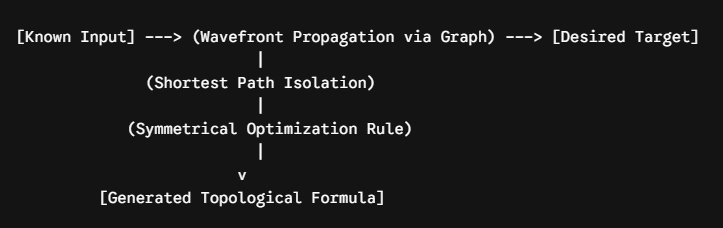
The algorithm starts at the input nodes, expanding outward into the neighboring cells of the matrix until it strikes the target cell. It then traces the shortest path backward, automatically stitching together the corresponding mathematical operations. Finally, an optimization layer cancels out redundant inverse operations (e.g., immediate multiplication followed by division).
This is the exact logical mechanism of a compiler optimizing an Abstract Syntax Tree (AST), but applied directly to the laws of nature.
3. The Topological Paradigm: Invariance and Differential Forms
As the script scales from basic kinematics to advanced Maxwell-Heaviside electrodynamics, it transcends simple algebra. Ignatov aligns the columns of his physical table with the laws of Discrete Exterior Calculus (DEC) and differential forms.
The table organizes physical fields into continuous vertical sequences:
-
0-forms and 1-forms transition into 2-forms and 3-forms via intrinsic spatial operations.
-
Because of the perfect mathematical symmetry built into the matrix, the system does not need to guess which vector calculus operator to use. Moving between adjacent cells automatically dictates whether the transformation requires a gradient, a curl (rotor), or a divergence.
By referencing Gabriel Kron’s early 20th-century algebraic topology networks and the “Diagram of the Champ” (1986), the script establishes that separate disciplines—electrostatics, magnetostatics, and elasticity—are structurally isomorphic. They are merely different expressions of the same underlying geometric tensor web.
4. The Generative Leap: From Formulas to Material Synthesis
Why is this an “embryo” of a hardware compiler?
In modern engineering, designing a silicon chip, a metamaterial lens, or a chemical catalyst involves a clumsy loop of trial, error, and heavy finite-element modeling (FEM). Designers guess a geometry, simulate the fields, and tweak the shape.
Ignatov’s approach provides the mathematical foundation to reverse this entire pipeline:
If a system can map the entire universe of electrodynamics, thermodyna mics, and material constants onto a unified, symmetric geometric algebra grid (as hinted by the script’s later integration with Python’s SymPy geometric algebra modules), we can treat physical space as code.
Instead of writing instructions for a CPU, a full-scale evolution of this compiler would take high-level boundary conditions—such as “generate an optical field structure that refracts light at $180^\circ$ with zero loss”—and mathematically decompose it through the matrix’s differential forms. The compiler would then output the exact physical topology—the precise arrangement of silicon atoms, chemical bonds, or waveguide boundaries—required to manifest that field.
Ignatov’s 2014 script was a primitive prototype. It looked like a text generator because it was constrained by the text-heavy ecosystem of Perl and CGI. But philosophically, it was the first step toward treating the laws of physics not as a set of rules to obey, but as an instruction set architecture (ISA) waiting to be compiled into physical form.
I am trying to expand on the thesis of compiling spatial topology directly into a physical outcome. For instance, when a peripheral LLM controls the application of arc-shaped grooves along the perimeter of an acoustic glass crystal, while ultrasonic excitation of a specific period and duty cycle shapes a predetermined vibrating surface pattern for laser illumination—this is no longer about programming instructions; it is about controlling field geometry.
I decided to reconnect with those with whom I once worked on complex engineering nodes. If you are interested in occasionally seeing my thoughts on the Prospects of MicroLM Development from this perspective, I will write from time to time…
P.S. I am currently building the physical prototype of the testbed (HMI/control unit) on industrial open-source hardware: [Olimex LCD-TS15.6] & [RuCap UM-5].